
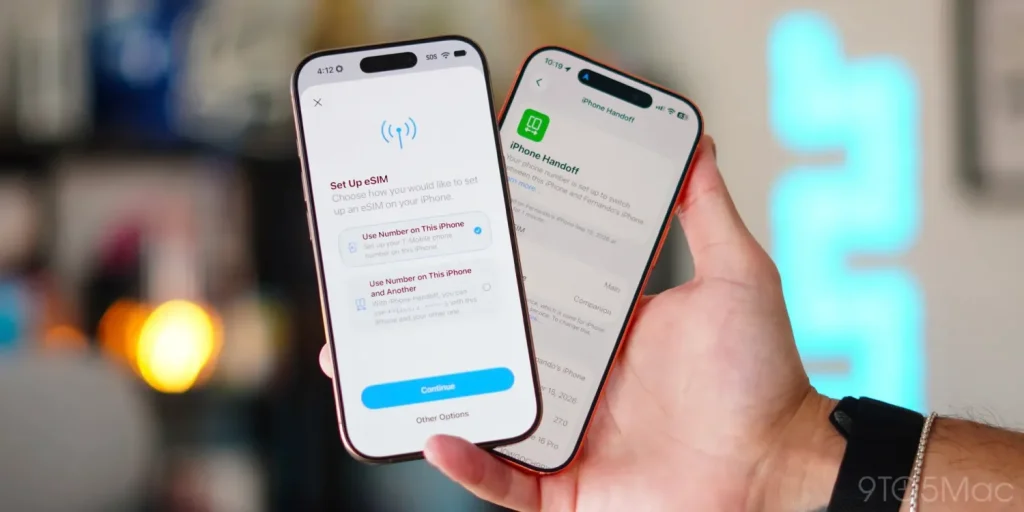
Apple last week launched a new iPhone Handoff feature, which lets you use a single phone number across two iPhones. The number intelligently moves between each iPhone based on whichever one you pickup.
As of right now, T-Mobile is the only carrier in the United States to support iPhone Handoff. Outside the United States, Telekom Germany is a launch partner for the feature.
Apple says that Verizon will add support by the end of the year, “with more carriers to follow. Apple says EE will add support by the end of the year.
I’ve been using iPhone Handoff for the last week as I’ve been testing the iPhone 18 Pro lineup, and it really does feel like magic. It is a bummer that T-Mobile is charging $5 per month for iPhone Handoff, though it’s not necessarily surprising. As reported by CNET , AT&T seemingly has no plans to support iPhone Handoff.
iPhone Handoff requires support from cellular carriers, and it sounds like AT&T isn’t interested in adopting the feature. They then pointed to “existing eSIM activation and transfer options across compatible devices. This will be upsetting news AT&T subscribers. As Apple promised, my number instantly switches to whichever iPhone I pick up. It’s still significantly cheaper than having a second cellular plan altogether. Have you tried iPhone Handoff yet? Is it a feature you’ll use on a regular basis? Let us know down in the comments. Follow Chance : Threads , Bluesky , Instagram , and Mastodon .
According to the report: “While we see that there could be potential in capabilities like iPhone Handoff,” the spokesperson replied, “our focus remains on delivering innovations that make life simpler and keep customers connected with confidence. The carrier’s emphasis on “existing eSIM activation and transfer options” seemingly indicates it doesn’t have a complete grasp on how iPhone Handoff works, and why it’s significantly more seamless than manually moving an eSIM back and forth between two iPhone models.
