
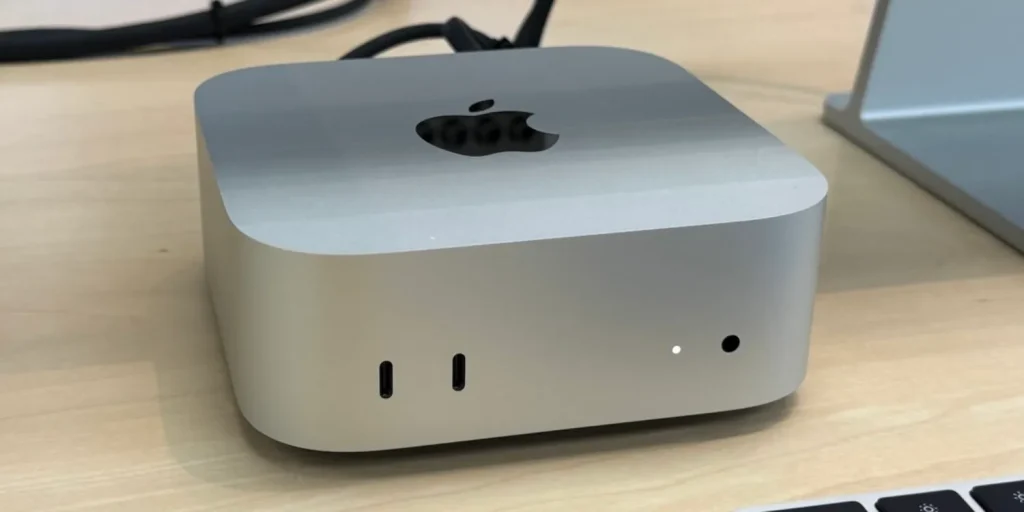
Over the last several years, the Mac mini has become one of the most compelling Macs in Apple’s lineup. It combines impressive performance with a compact footprint, making it versatile enough for all kinds of workflows.
Performance
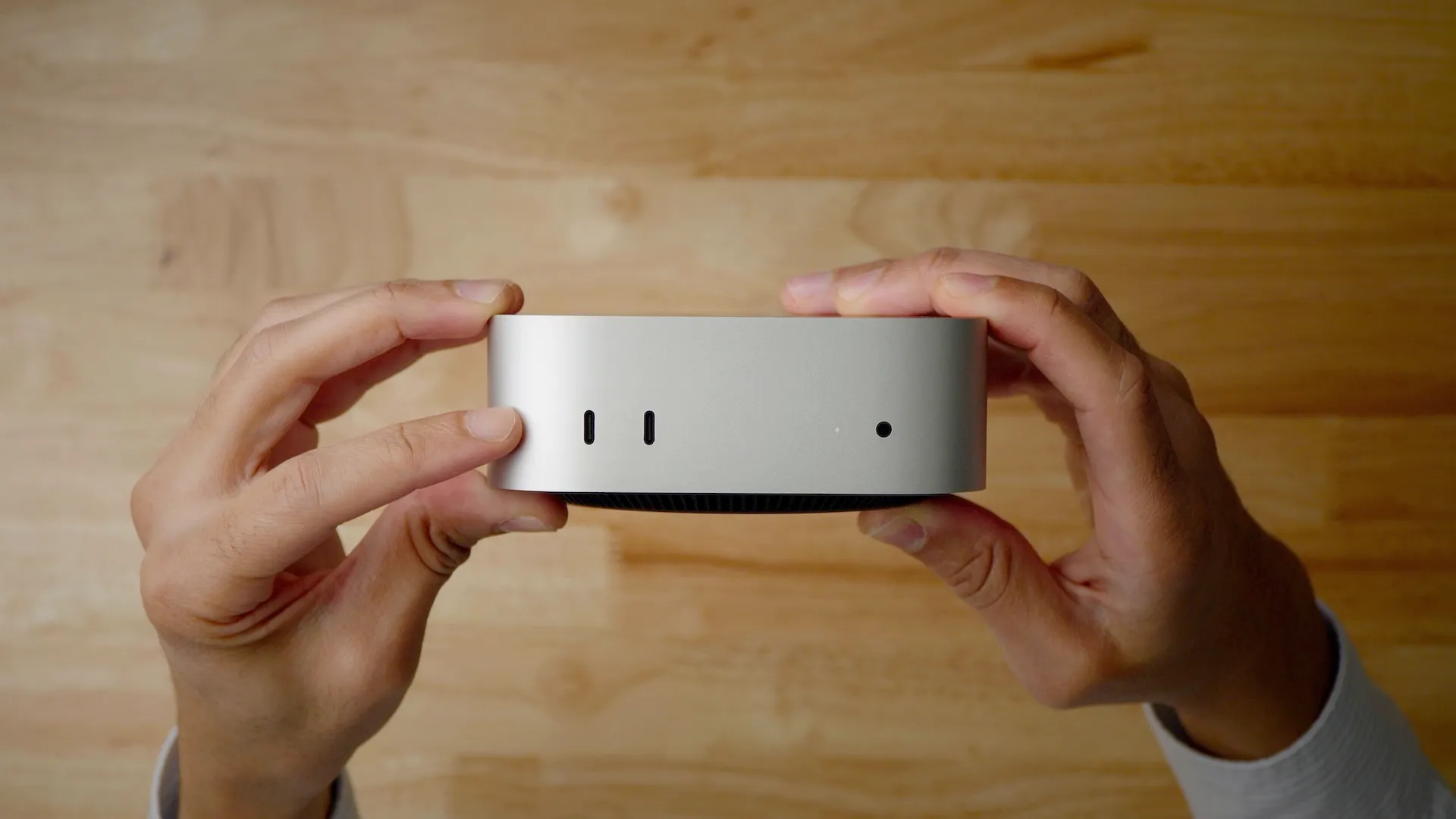
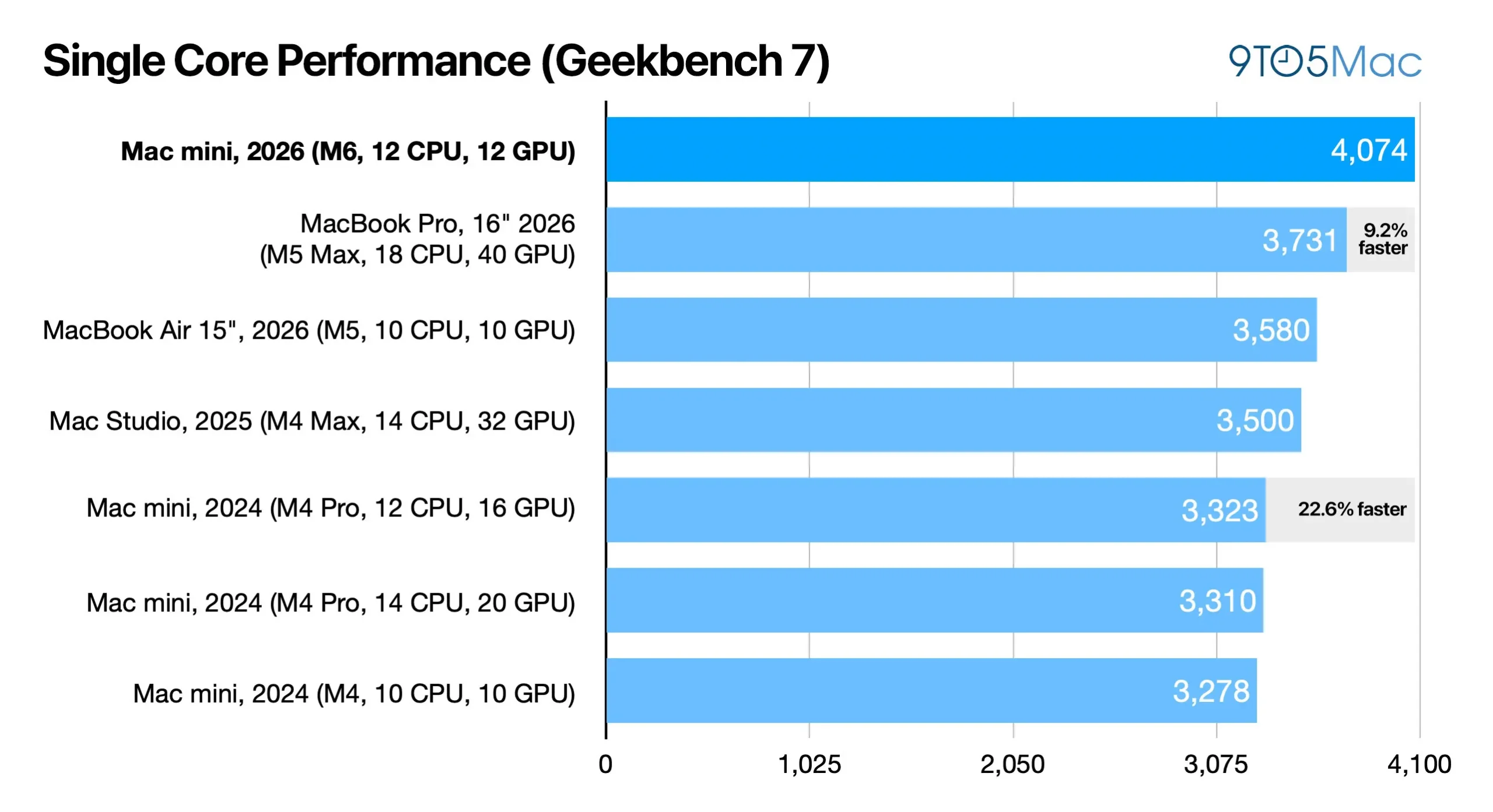
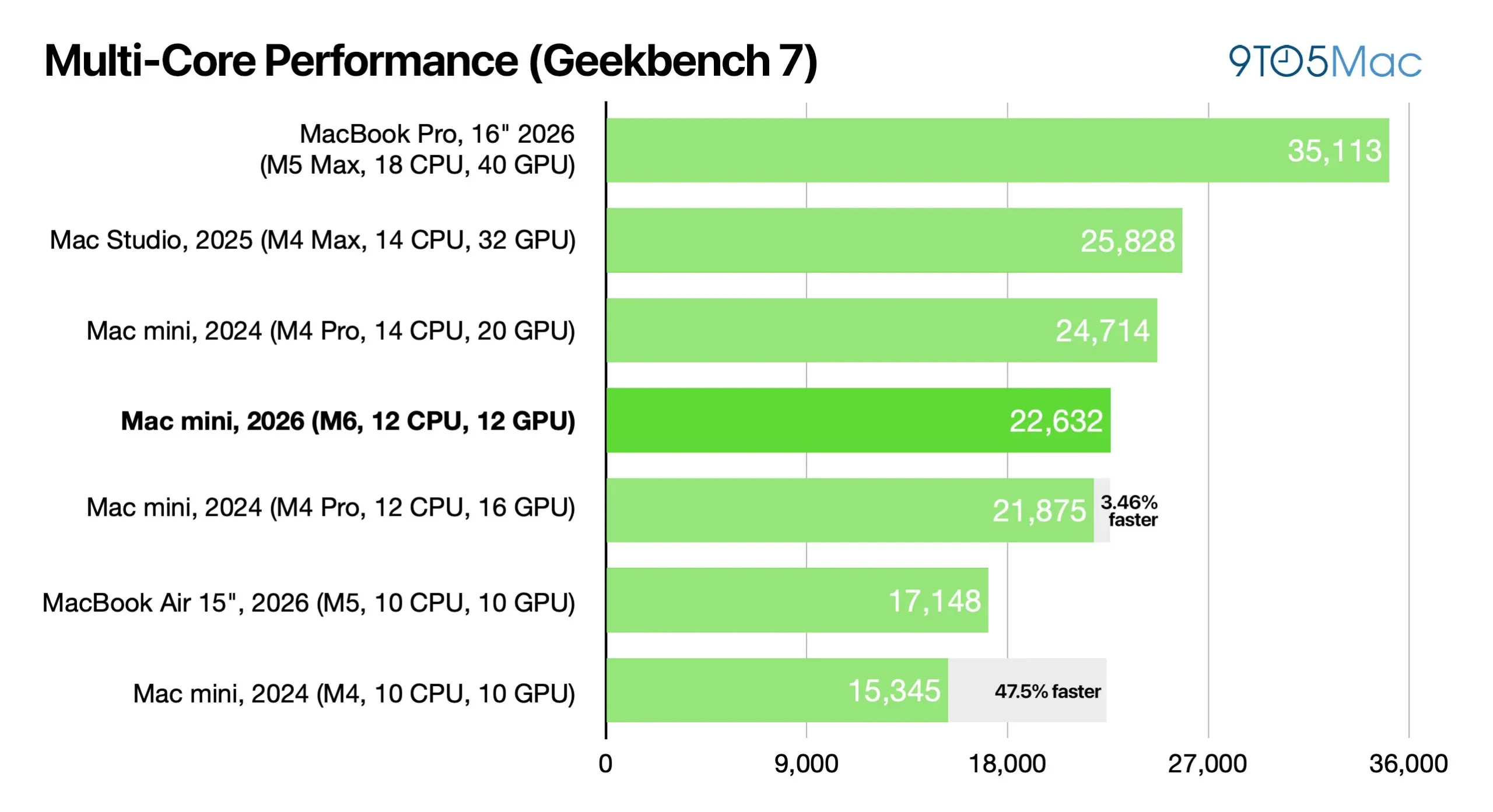
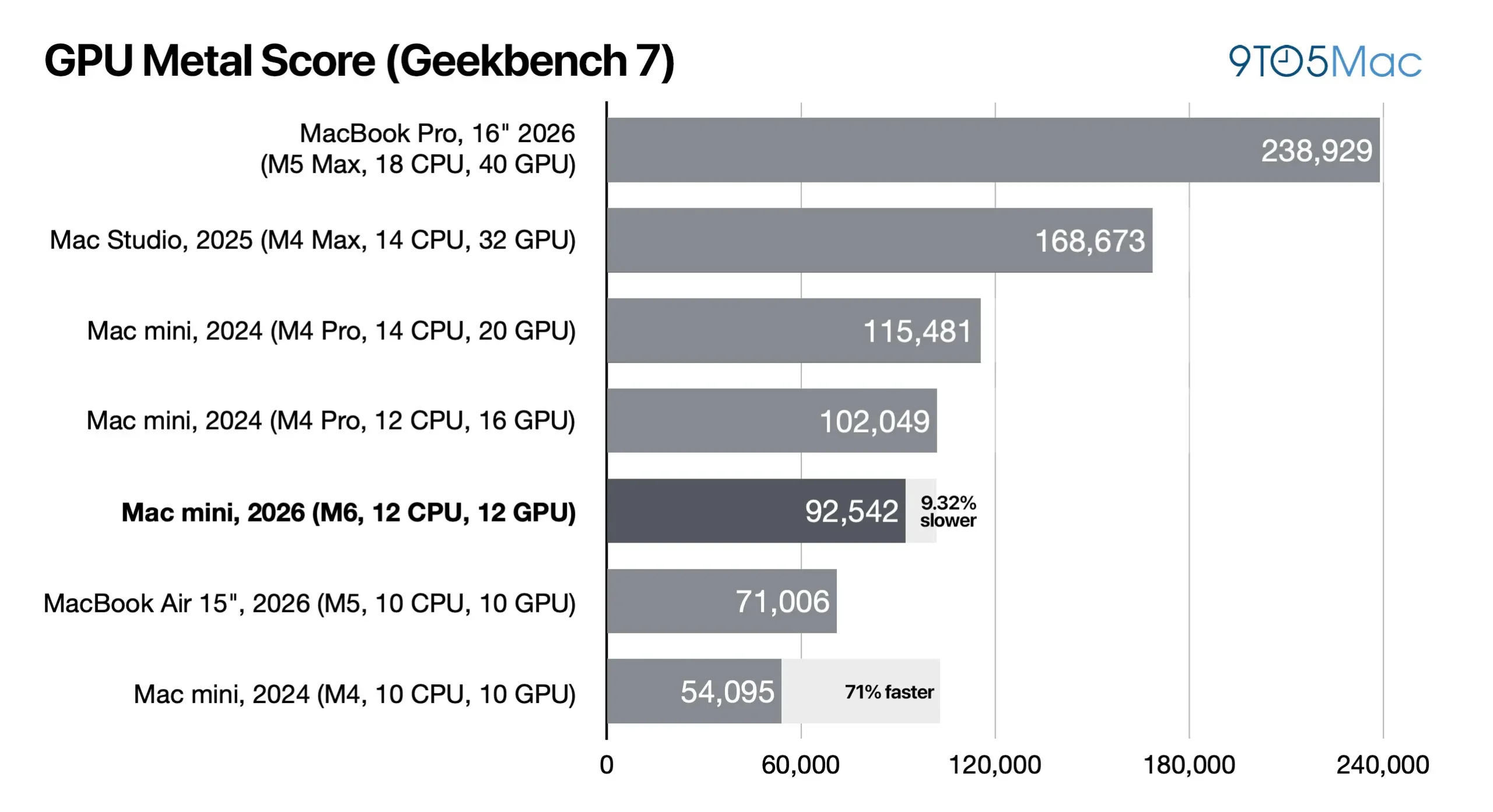
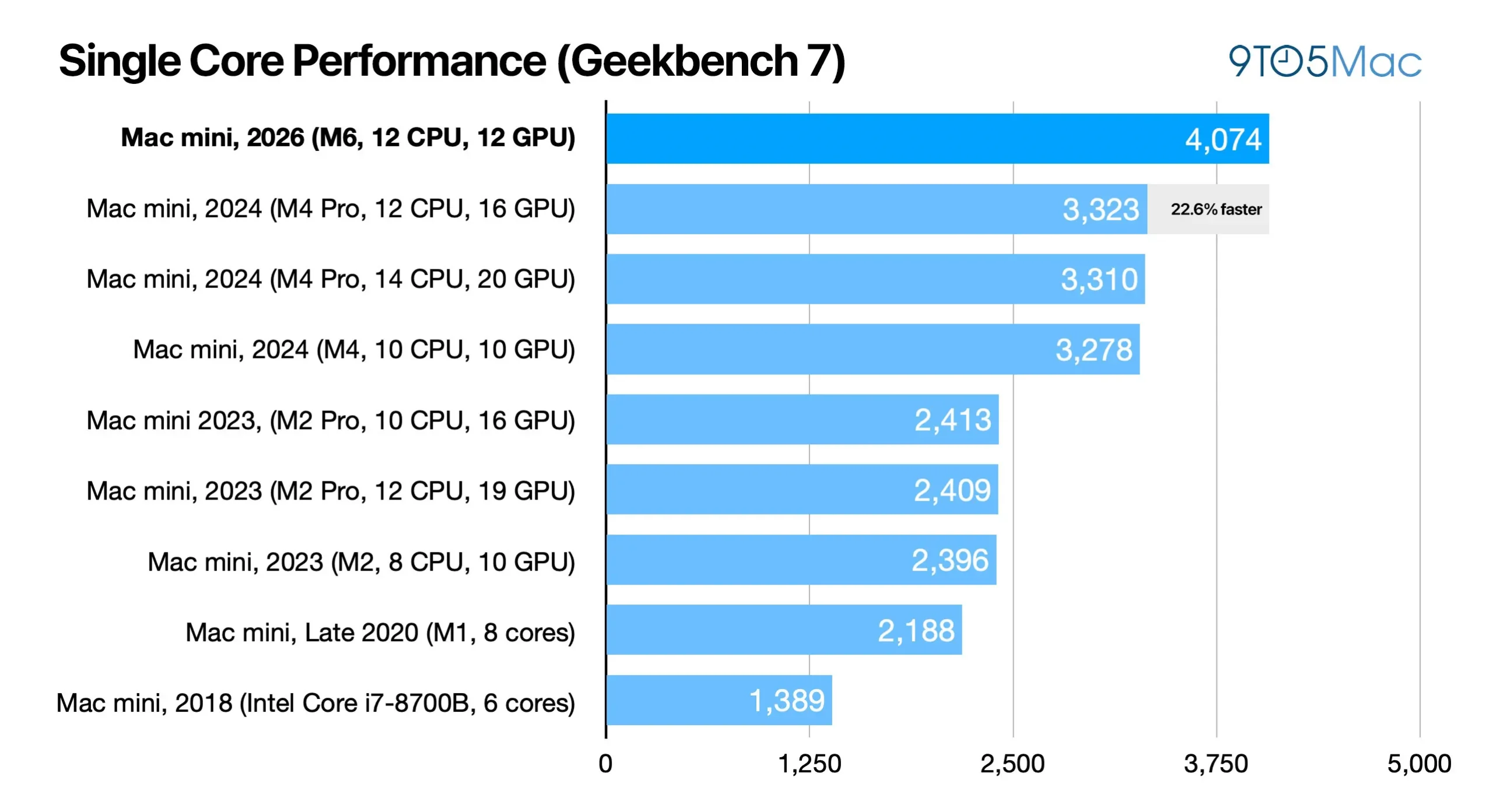
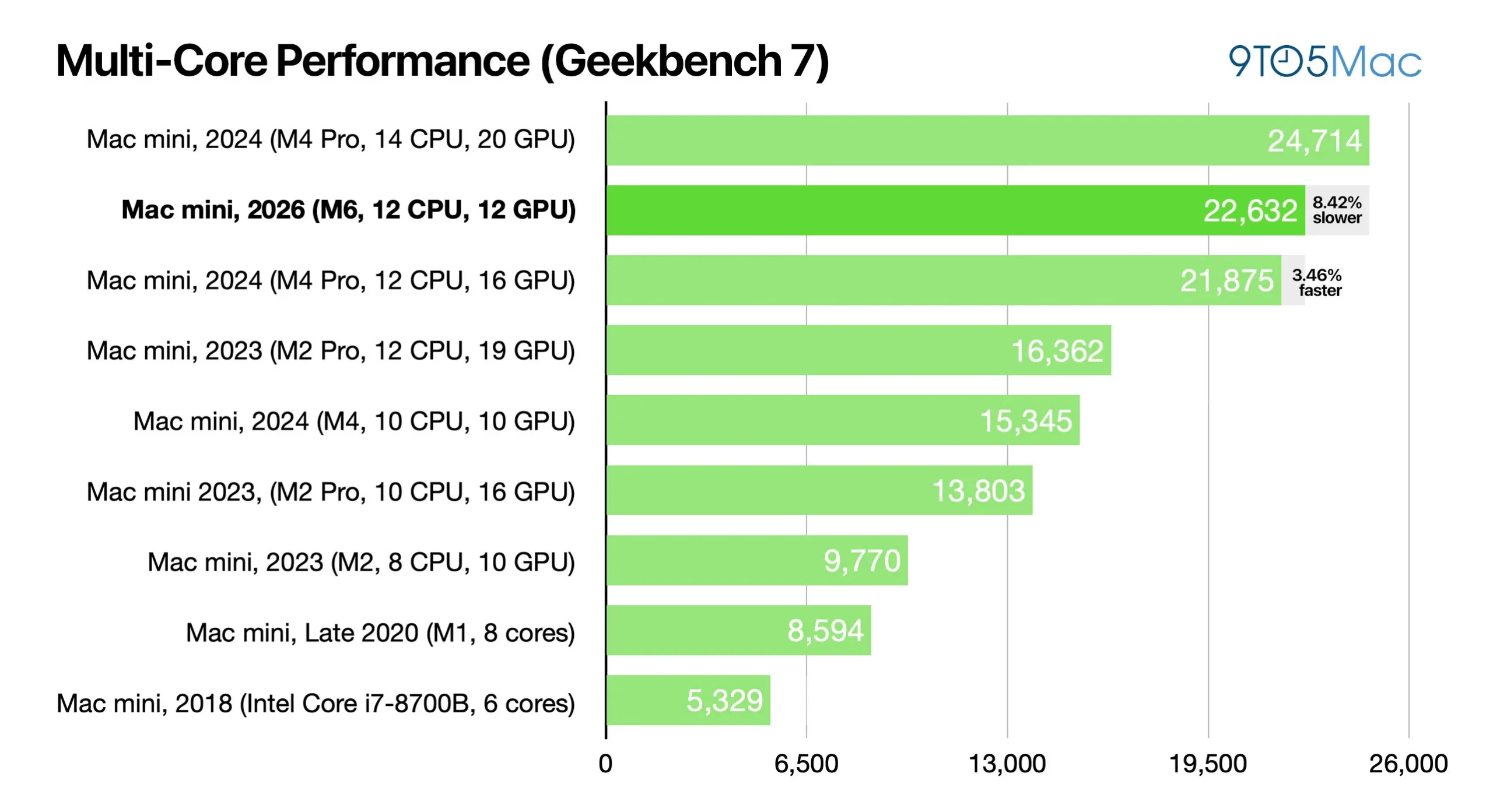
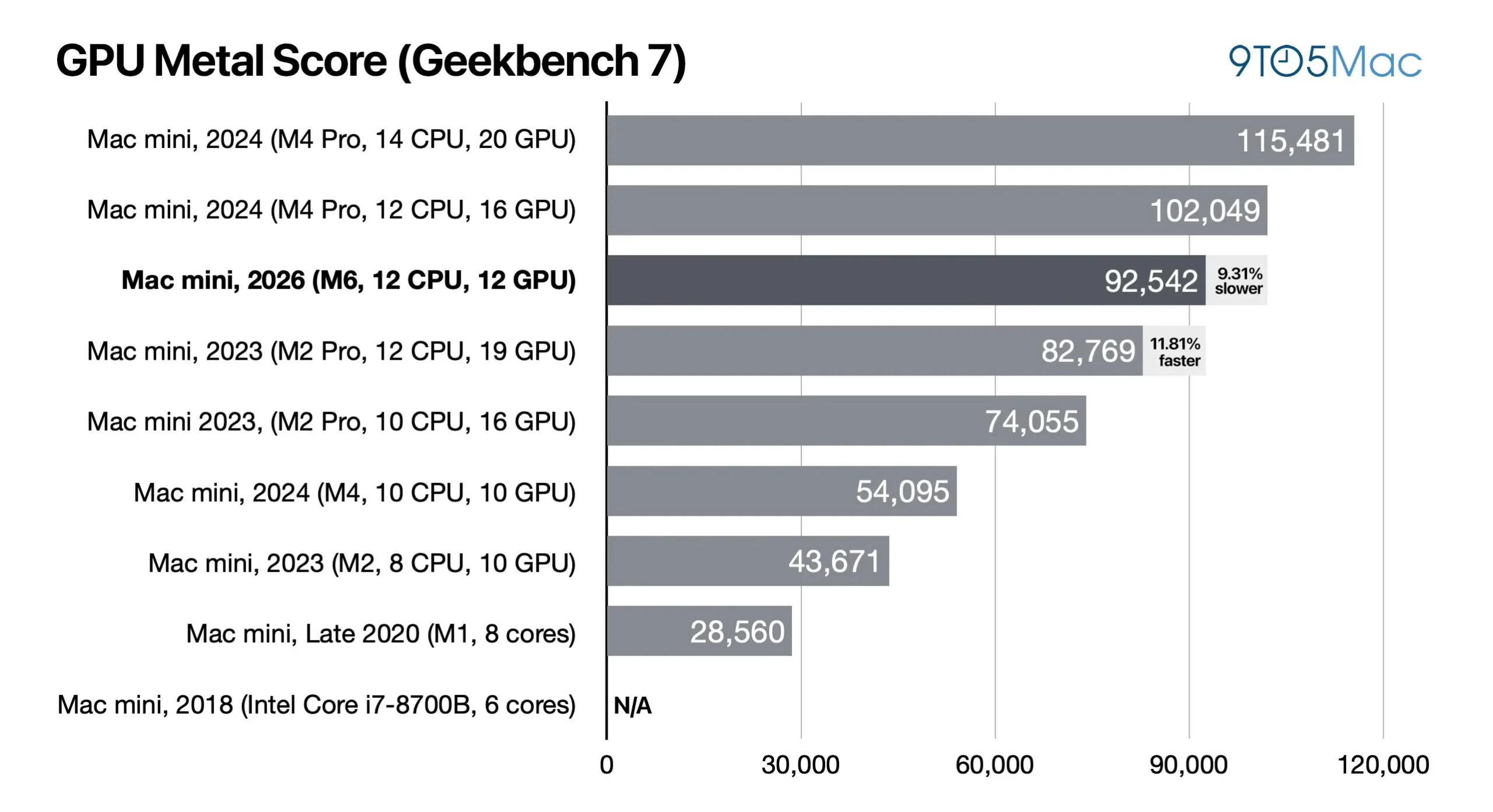
Apple gave the Mac mini its first proper redesign in more than a decade in 2024, dramatically shrinking its footprint to just 5 by 5 inches. On the front, you’ll find two USB-C ports and a 3.5mm headphone jack. On the back of the M6 configuration, you’ll find three Thunderbolt 4 ports, while the M5 Pro version features three Thunderbolt 5 ports. One nice change: 2.5Gb Ethernet is now standard on both the M6 and M5 Pro configurations. The other two connectivity updates for the new Mac mini models include Wi-Fi 7 instead of Wi-Fi 6E and Bluetooth 6 instead of Bluetooth 5.3. It’s also Apple’s first chip to use all three of its CPU core types: 2 super cores, 4 performance cores, and 6 efficiency cores. The M6 also features a new 12-core GPU, up from the 10-core GPU in the M4. Here’s Federico Viticci, whose AI opinion I trust, on the new Mac Studio: In Geekbench 7 testing, the M6 Mac mini scored 4,074 in single-core, 22,632 in multi-core, and 92,542 in the Metal GPU test. That puts it 24% ahead of the M4 in single-core performance, 48% ahead in multi-core performance, and 71% ahead in GPU performance. As you can see, the M6 also starts to encroach on M4 Pro territory, beating the 12-core M4 Pro in both single-core and multi-core performance, though the M4 Pro still has the edge in GPU performance. I consistently hit around 6,000-6,400 MB/s write speeds and 6,000-6,300 MB/s read speeds in Blackmagic Disk Speed Test. For comparison, 512GB M4 Mac mini configurations generally reached around 3,000 to 3,400 MB/s. When Apple debuted the redesigned Mac mini in 2024, we marveled at the price. It started at $599 with the M4 chip paired with 16GB of memory and 256GB of storage. This raised the pricing floor from $599 to $799. When Apple raised prices for most products over the summer, the 256GB Mac mini configuration returned, priced at $799 (up $200 compared to its launch price). The M6 Mac mini starts at $899 for 256GB of storage and 16GB of memory. The M5 Pro configuration starts at $1,699, up $300 from the M4 Pro launch price and up $100 from the M4 Pro’s most recent price. The thing that stands out to me, though, isn’t necessarily the $899 starting price. Instead, upgrading to 512GB of storage costs an additional $200, pushing the price to $1,099.
I won’t pretend to regularly run local AI models or other on-device AI workflows, so I don’t have much real-world insight to offer here. I’ve spent the last week using the M6 Mac mini, and it pushes that formula even further. Here’s everything you need to know. From the outside, the new Mac mini looks identical to its predecessor. There’s something about having the small but powerful Mac mini on my desk that just makes me smile. The amount of power Apple has packed into this tiny footprint is nothing short of impressive. It’s a delightful example of Apple’s design team at its best, without compromising performance or connectivity. There’s also an HDMI port on the back. The M4 models started at gigabit Ethernet. 10Gb remains an optional upgrade. For external displays, both versions of the Mac mini support up to three displays, but specifics vary based on the chip: My review unit is the M6 configuration of the Mac mini, so I’m going to focus on that for most of this review. Here are the specs of my review unit: The M6 chip has two additional CPU cores compared to the M4 and M5 chips. It’s Apple’s first 2nm processor for the Mac. The super cores prioritize maximum single-threaded performance, while performance cores are optimized for multithreaded workloads. The efficiency cores handle lighter background tasks. Memory bandwidth has also increased significantly, from 120GB/s with the M4 to up to 170GB/s with the M6 (153GB/s on the 16GB configuration). Each GPU core also includes a Neural Accelerator, helping the M6 deliver up to 4x faster AI performance than the M4 Mac mini. But for people who do, Apple’s own testing suggests the gains are real. Geekbench results, of course, aren’t necessarily indicative of real-world performance. Instead, they’re good for cross-reference comparisons to other Macs. The Mac mini has become a go-to recommendation for people looking for dedicated machines to run AI agents and other AI workflows . In May, Apple stopped selling the 256GB storage configuration for the M4 Mac mini, making the base configuration 512GB. At the time, it was reasonable to think this was Apple insulating the Mac mini from any future increases (at least in the short term). Unfortunately, that wasn’t the case. It’s that you still only get 256GB of storage. If the M6 Mac mini started with 512GB of storage, I don’t think there would be much room to complain about the price. There’s a lot to love about the new Mac mini, including the faster performance and storage, all with the same great design. That combination of performance and design also makes it the most versatile Mac Apple sells, whether you’re using it as a desktop, an always-on server, a machine for running AI agents, or something else entirely.
Apple says graphics performance is up to 2x faster than the M4 Mac mini, including up to 2x faster ray-traced rendering in Blender. Apple also says the M6 Mac mini offers up to 2x faster storage, and my benchmarking supports that. We’ve entered what former Apple CEO Tim Cook has called a “ 100-year flood ” in terms of memory prices, and there are no signs of that ending anytime soon.
The M5 Pro version is the same chip we’ve come to know and love since debuting in the MacBook Pro earlier this year. A lot has changed since then. That same design persists today, and it’s still incredibly easy to love.
So, the good news is the Mac mini is better than it’s ever been. I love that we live in a world where the Mac mini is thriving. Apple’s smallest Mac, which has occasionally felt neglected, is having its well-deserved moment in the spotlight. Is it a little awkward that the Mac mini comes in M6 and M5 Pro configurations, as opposed to M6 and M6 Pro? On paper, sure, but practically I’m glad that Apple is focused on updating the Mac mini with whatever chips are ready at a given moment. That flexibility is one of the best things about the Apple Silicon era.
The bad news is that it’s no longer the exceptional $599 value it was two years ago … it’s just a really good value instead.
While the higher starting price changes the value equation, it doesn’t change my overall feelings about the Mac mini. It’s still an easy Mac to recommend for people who want a compact desktop Mac without spending substantially more for a Mac Studio. Follow Chance : Threads , Bluesky , Instagram , and Mastodon .
